
Semaglutide Cost in 2026: Brand, Compounded, Insurance
September 7, 2026
By Dr. Paul Frandsen, MD · September 7, 2026 · 22 min read
Medically reviewed by Dr. Paul Frandsen, MD

Semaglutide cost has no single number. What you pay each month depends on which product you’re prescribed (a Wegovy pen or tablet, Ozempic, or Rybelsus), the dose you reach, and who pays (insurance, Medicare, a savings offer, cash, or a compounded medication). Check your plan first, then price the path that fits, ideally with a clinician who manages medical weight loss in American Fork and can run the paperwork.
The maker sets a list price, but few people pay it in full. Most people pay a plan copay, a manufacturer self-pay price, or, if they qualify, Medicare’s new $50 monthly copayment under the temporary Medicare GLP-1 Bridge. The rest of this guide walks through each path, what moves the number, and what to ask before you fill anything.
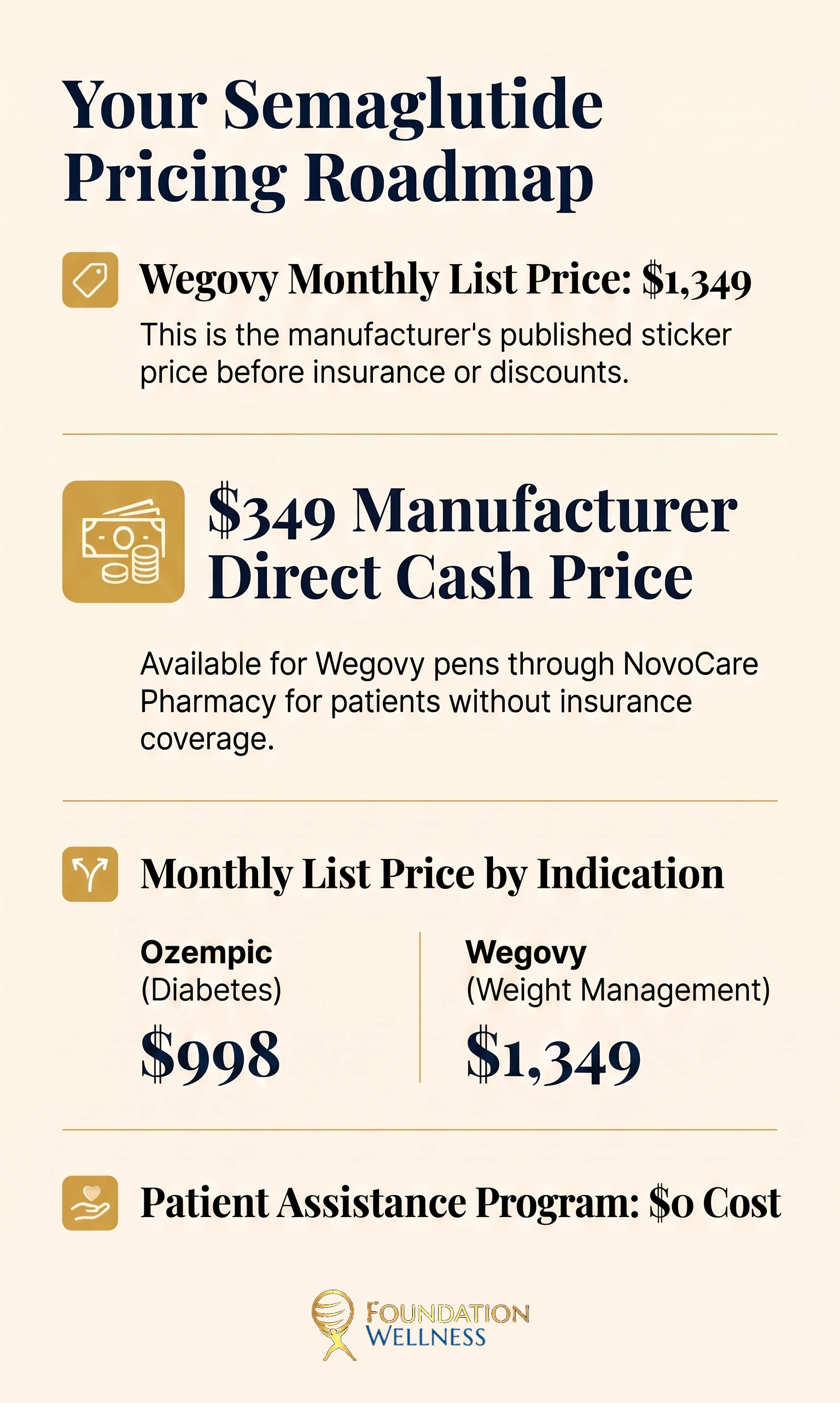
How Much Does Semaglutide Cost Per Month?
Here’s the thing: three numbers matter, and they’re rarely the same.
List price is the sticker the manufacturer publishes. Hardly anyone pays it in full, but it still reaches you through a deductible or coinsurance, because your share is calculated from it. It also changes, so check it on the day you fill.
Cash or self-pay price is what you pay with no plan involved. Novo Nordisk, the maker of Ozempic, Wegovy and Rybelsus, sells some products directly through its own channel, NovoCare Pharmacy, at a self-pay price well below list. Price that route yourself if you have no insurance coverage for weight management at all.
Your copay is what hits your card when the drug is covered. It can be low, or much higher before you meet your deductible.
One dollar figure comes from a federal source: Medicare lists a $50 copayment for a one-month supply of certain GLP-1 drugs, including Wegovy, for people who qualify for the Medicare GLP-1 Bridge. That’s Medicare’s figure, not a Foundation Wellness price, and the rules are narrow (see the Medicare section).
Why no list prices here? Honestly, because the published figures sit on manufacturer pages and they move. A figure printed today could be stale by the time you read it. Treat this guide as a map of where the money goes, then confirm your real number with your own plan and pharmacy.
What Is Semaglutide, and Why Does One GLP-1 Medication Have Several Prices?
Semaglutide is a glucagon-like peptide-1 (GLP-1) receptor agonist. In plain terms, it’s a GLP-1 medication that acts on the body’s appetite and blood sugar signals. The same active ingredient sits inside several branded products, and each one carries its own label, its own approved uses, and its own price story.
- Ozempic is a once weekly semaglutide injection approved for blood sugar control in type 2 diabetes.
- Rybelsus is a daily semaglutide tablet, also for blood sugar control in type 2 diabetes.
- Wegovy is approved for weight management, and it now comes as a weekly injection and as a daily tablet.
According to the Wegovy prescribing information on DailyMed, Wegovy injection and Wegovy tablets are used together with a reduced calorie diet and more physical activity. They’re approved to reduce excess body weight and keep that weight reduction long term in adults with obesity, or in adults with overweight who have at least one weight-related condition. Both forms are also approved to reduce the risk of major cardiovascular events, such as heart attack or stroke, in adults with established cardiovascular disease and either obesity or overweight.
Same molecule, several labels, several prices. Confusing? Very. That split explains most of the confusion about price.
Semaglutide Cost by Path: Brand, Compounded, Medicare and Insurance Coverage
Start with the path. Then find what actually sets the number on that path. The table below lists no list prices on purpose; the only dollar figure in it’s Medicare’s own.
| Path | What it’s | What sets your monthly cost | Where to check |
|---|---|---|---|
| Wegovy injection or tablet at list | Brand weight management product | The maker’s list price; it bites if you have a deductible or coinsurance | The maker’s current published price |
| Ozempic injection at list | Brand type 2 diabetes product | Approved for blood sugar, not for weight | Your plan’s formulary |
| Manufacturer self pay | The maker’s direct cash channel | A flat cash price, no plan involved, no prior authorization | The maker’s current self-pay price |
| Commercial insurance coverage | Plan copay or coinsurance | Formulary tier, deductible, prior authorization | Your pharmacy benefit |
| Weight management excluded | Full cash price | Your employer’s benefit design, not a clinical call | Your plan documents |
| Medicare GLP-1 Bridge | Temporary Medicare program for eligible people with Part D coverage | $50 copayment for a one-month supply (Medicare’s figure) | Medicare.gov |
| Compounded semaglutide | Compounded medication, not FDA approved | The pharmacy, the dose, a documented medical need | The prescriber and the pharmacy |
One warning: a compounded semaglutide price advertised as an introductory rate deserves a close look, because the starting dose is far lower than the dose most people reach.
What Drives the Price of a GLP-1 Medication?
People often assume one true price exists and someone is hiding it. Understandable. But that isn’t what happens. Six separate levers move your number, and they move independently.
- Which brand you’re prescribed. Each product has its own list price and formulary position, and your diagnosis usually decides which one can be written.
- Your dose. Semaglutide is stepped up over months, and some channels price by strength.
- Medical or pharmacy benefit. These are often run by different companies inside the same insurance plan; for a weight loss medication from a pharmacy, the pharmacy benefit usually decides.
- Your deductible status. Early in the plan year you may pay close to list price; after the deductible, far less.
- The channel. Retail pharmacy, mail order, the maker’s direct channel and a compounding pharmacy all price differently.
- Program fees around the drug. Some clinics bundle labs, visits and supplies into one fee; others bill each piece.
Coinsurance is where the arithmetic gets uncomfortable. A copay is a flat amount. Coinsurance is a percentage of a price that starts from the list price, so the higher the list price, the bigger your share. Nothing about the drug changed. Only the contract did.
And rebates make this messier still. The list price isn’t what the manufacturer keeps after rebates flow back to plans and pharmacy benefit managers, which is why a pharmacy receipt can feel disconnected from any figure you read online.
Ozempic Cost vs Wegovy: Why One Molecule Has Two Prices
Ozempic and Wegovy contain the same active ingredient but differ in approved use and dose, and that decides coverage. An employer plan may pay for Ozempic for a person with type 2 diabetes and decline Wegovy for a person with obesity and no diabetes. The chemistry is identical. The benefit design isn’t.
So why not write the diabetes product to get the lower Ozempic cost on your plan? Prescribing a drug for a use that’s different from what the FDA approved is called off-label use. The National Institute of Diabetes and Digestive and Kidney Diseases explains that you should feel comfortable asking whether your provider is prescribing a medication that isn’t approved for treating overweight or obesity. Chasing a lower copay isn’t a good reason to do it. It can also fail on its own terms, because plans can check the diagnosis on the claim against the approved use.
The better move is to read the prescribing information for the product you’re offered, with your healthcare provider.
Does Insurance Coverage Include Semaglutide for Weight Loss?
Sometimes. The answer swings hard from one plan to the next, and it often swings for reasons that have nothing to do with your health. Which is frustrating, frankly.

The NIDDK guide to prescription medications for overweight and obesity puts it plainly: some, but not all, insurance plans cover medications that treat overweight and obesity, so contact your insurance provider to find out whether yours does. The same guide notes who a health care professional may prescribe a weight management medication to. That’s an adult with a body mass index (BMI) of 30 or greater, or a BMI of 27 or greater with weight-related health problems such as high blood pressure or type 2 diabetes.
Some plans cover a weight loss medication outright. Some cover semaglutide only for type 2 diabetes and blood sugar control. Some leave weight management off the formulary entirely. That last one is a purchasing decision your employer or plan made, and no appeal from your healthcare provider will reverse it.
Where insurance coverage exists, it arrives with conditions attached.
| Coverage path | What it usually requires | What you usually pay |
|---|---|---|
| Commercial insurance with a weight benefit | Documented BMI, earlier weight loss attempts, prior authorization | Plan copay or coinsurance |
| Commercial insurance, diabetes only | Type 2 diabetes diagnosis, blood sugar labs on file | Plan copay or coinsurance |
| Plan with weight management excluded | Nothing unlocks it; it’s a benefit design choice | Full cash price |
| High deductible plan before the deductible | Same paperwork, no cost relief yet | Close to list price |
| No insurance coverage | The maker’s self-pay channel | The maker’s cash price |
| Patient assistance program | Income documents, proof of little or no coverage | Set by the program |
| Compounded semaglutide | A documented medical need the approved drug can’t meet | Varies by pharmacy |
Foundation Wellness accepts many insurance plans. Coverage depends on your plan, so check with our office first. We won’t guess at your coverage from the name on your card, and you should be wary of anyone who does.
What Does a Prior Authorization for a Weight Loss Medication Need?
A prior authorization is your plan’s review before it agrees to pay. For a weight loss medication, most plans want three things before they approve anything: a documented BMI, a record of earlier weight loss attempts, and a clinical rationale tied to the approved prescribing information for the product being requested. Many also want weight-related conditions on file, such as high blood pressure or prediabetes.
Some plans add step therapy: you try a preferred medicine first and document why it didn’t work before the plan covers the one you were prescribed.
How long does it take? That depends on your insurance plan, and no one can promise a number of days. Annoying answer, we know. What slows a request down is a missing piece, such as no BMI history or a diagnosis that doesn’t match the approved use. Every round trip adds time.
If you get a denial, ask for the reason in writing. Three outcomes are common:
- Missing documentation. Usually fixable. Resubmit with the gap filled.
- Step therapy required. Also workable. Document the trial of the preferred drug and move forward.
- Plan exclusion. Not fixable through appeal. At that point the conversation shifts to cash pricing, a savings or assistance program, or a different treatment plan.
Knowing which of those three you face saves weeks. Ask your insurance plan early for the exact criteria it uses.
Does Medicare Part D Cover Semaglutide for Weight Loss in 2026?
Yes, for some people, through a new and temporary program. This is probably the biggest pricing change this year.
Medicare drug plans long left out drugs used only for weight loss. That changed on July 1, 2026. According to Medicare’s page on weight loss drugs, starting that day Medicare covers certain GLP-1 medications under the Medicare GLP-1 Bridge: Wegovy (injection or tablet), Foundayo (tablet), and Zepbound (the KwikPen only, not single-dose vials or pens).
The Bridge is available nationwide, including in Utah, to certain people with Medicare drug coverage (Medicare Part D). That includes a standalone Medicare drug plan, a Medicare Advantage plan with drug coverage, a Special Needs Plan, an employer or union group waiver plan, and the Limited Income Newly Eligible Transition (LI NET) program.
You must be 18 or older. You also need to meet one of these when you start GLP-1 therapy.
| Your BMI | Plus at least one of these conditions |
|---|---|
| 35 or higher | None needed |
| 30 or higher | Diastolic heart failure, uncontrolled high blood pressure, or chronic kidney disease at stage 3a or higher |
| 27 or higher | Prediabetes, a previous heart attack or stroke, or blocked arteries in your legs or arms (peripheral artery disease) with symptoms |
You aren’t eligible for the Bridge if you already get GLP-1 drugs covered through your Medicare Part D plan, or if you have type 2 diabetes, moderate to severe sleep apnea, or fatty liver disease. In those cases, Medicare says your Part D plan might cover your GLP-1s instead.
Your provider has work to do too. They send a prescription for a covered GLP-1 drug to the pharmacy and, when requested, complete a prior authorization. They must also certify that you’re using the drug as part of a lifestyle program that focuses on diet and exercise. Once approved, the prior authorization is valid, including for refills and dose changes, through December 31, 2027, unless you change GLP-1s.
What does it cost? Medicare lists a $50 copayment to the pharmacy for a one-month supply (28 or 30 days, depending on the drug). Because a separate Medicare program covers the drug, that copayment doesn’t count toward your yearly Part D deductible or out-of-pocket limit, can’t be lowered by Extra Help, and can’t be spread across months with the Medicare Prescription Payment Plan.
If you aren’t on Medicare, none of this applies to you. State Medicaid and marketplace plans run their own rules, so check those separately rather than assuming they match.
Savings Offer or Patient Assistance Program: Which One Applies?
These two get confused constantly, and they aren’t interchangeable.
A savings offer from the manufacturer reduces a copay you already have. It usually requires commercial insurance that already covers the drug, and copay programs like this generally don’t apply to anyone on Medicare or Medicaid. The maker publishes the terms for each product, and they change, so read the current terms before you count on one.
A patient assistance program is different. It’s income based help for people with little or no coverage, and it usually needs tax documents and a longer review. Medicare’s own page suggests checking whether the company that makes your drug offers help paying for it, and finding out whether your state offers help with drug costs.
| Program type | Who qualifies | What it changes | Typical timeline |
|---|---|---|---|
| Manufacturer savings offer | Commercial insurance, drug already covered | Lowers an existing copay | At the pharmacy once enrolled |
| Manufacturer self-pay pricing | Anyone paying cash | Replaces list price with a flat cash price | Varies |
| Patient assistance program | Lower income, little or no insurance | Reduces cost, sometimes to zero | Longer review |
| Drug discount sites | Anyone | A lower cash price for one fill | At the pharmacy |
One caution about copay cards. They can interact badly with accumulator programs run by some pharmacy benefit managers, meaning the manufacturer’s help doesn’t count toward your deductible. Ask your plan whether an accumulator applies before you assume the card solved your year.
On Medicare? Medicare notes that a drug bought with a discount card instead of your plan doesn’t count toward your Medicare deductible or out-of-pocket maximum.
How Much Does Compounded Semaglutide Cost, and Is It Safe?
Compounded semaglutide cost varies by pharmacy, dose and what is bundled in, so there’s no one number. What we can give you is a way to judge an offer. The FDA’s compounding questions and answers is clear that compounded drugs aren’t FDA approved. The FDA doesn’t verify their safety, effectiveness or quality before they’re marketed. Compounders may also prepare versions of a drug on the FDA’s drug shortage list, but only if the compounded drug meets conditions set in federal law.
The FDA has also published its concerns with unapproved GLP-1 drugs used for weight loss, and they bear directly on compounded GLP-1 medications. Here’s what it says.
- Compounded drugs should only be used in patients whose medical needs can’t be met by an FDA-approved drug.
- The FDA has received reports of adverse events, some requiring hospitalization, that may be related to dosing errors with compounded injectable semaglutide, and reports tied to doses beyond what the approved label allows.
- Salt forms, including semaglutide sodium and semaglutide acetate, are different active ingredients from the one in the approved drugs, and the FDA says it isn’t aware of any lawful basis for their use in compounding.
- The FDA is aware of fraudulent compounded semaglutide with false label information, sometimes naming a compounding pharmacy that doesn’t exist.
- Multi-dose vials should be discarded 28 days after first use, even if medication remains.
- Don’t use any injectable GLP-1 drug that arrives warm or without enough refrigeration.
The same page lists telehealth red flags. Watch for a company that claims a compounded drug is the same as an FDA-approved drug, or offers medicine at deep discounts or prices that seem too good to be true. Be just as wary if it doesn’t require a screening and prescription by a licensed doctor, or has no licensed doctor available to answer questions after you receive your medication.
Look, that red flag is the real answer on compounded pricing: a very low number isn’t a bargain if you can’t tell what is in the vial. If a compounded product genuinely fits your case, a licensed provider should supervise it and use a state-licensed pharmacy.
Is the Wegovy Pill Cheaper Than the Semaglutide Injection?
Short version first. There’s no Ozempic pill. Surprising to a lot of people, but true. Ozempic is a weekly injection. People who search for an Ozempic pill are usually looking for oral semaglutide, which comes in two forms: Rybelsus, a daily tablet for blood sugar control in type 2 diabetes, and Wegovy tablets for weight management.
The Wegovy pill follows its own label. You start at 1.5 mg once daily for 30 days, then step up every 30 days through 4 mg and 9 mg to a maintenance dose of 25 mg once daily. The tablets come in 1.5 mg, 4 mg, 9 mg and 25 mg strengths.
The timing rules are strict. Fussy, even. Take one tablet in the morning on an empty stomach with up to 4 ounces of water, and no other liquid. Swallow it whole. Then wait at least 30 minutes before eating, drinking, or taking other oral medicines. Those rules affect how well it works, which affects whether the money was worth spending.
Is the pill cheaper than the injection? Not as a rule. It depends on which form your plan covers, its tier, and the self-pay price for your maintenance strength. Compare the monthly price at the dose you’ll actually stay on, not the starting dose. Under the Medicare GLP-1 Bridge, Medicare lists Wegovy injection or tablet with the same $50 copayment for a one-month supply.
A tablet is a real option if needles bother you. Pick the form that fits your health and routine first, then price it.
Does a Higher Dose Change Your GLP-1 Therapy Cost?
It can, and the dose schedule is worth knowing before you budget. The Wegovy label starts the injection at 0.25 mg once weekly and steps it up every 4 weeks, through 0.5 mg, 1 mg and 1.7 mg. From week 17 the usual maintenance dose for weight reduction in adults is 2.4 mg once weekly, with 1.7 mg as an option. If you tolerate 2.4 mg for at least 4 weeks and more weight reduction is clinically indicated, the label now allows a maximum of 7.2 mg once weekly, given with a separate higher-strength pen (WEGOVY HD).
What that means for semaglutide injection cost depends on the channel:
- Some self-pay pricing is set by strength. Ask what each step costs, especially the 2.4 mg and 7.2 mg strengths.
- Some arrangements are flat across doses. Ask in writing, because flat pricing can change.
- Insurance may treat a higher strength differently. A dose change can mean a new prior authorization request or a quantity check.
- Under the Medicare GLP-1 Bridge, Medicare lists one $50 copayment for a one-month supply, and the prior authorization covers dose changes through December 31, 2027.
A higher dose is a clinical decision, not a pricing one. Your prescriber weighs your response and how well you tolerate it. Ask what happens to the price at each step of your GLP-1 therapy, because the step-ups are where surprise bills tend to appear.
The Real Monthly Cost: Medication Plus GLP-1 Therapy Care
Pricing the pen isn’t pricing the treatment. A semaglutide program has moving parts, and the medication is only the largest one.

| Cost component | How often | Why it exists |
|---|---|---|
| Semaglutide medication | Monthly | The drug itself, priced by brand, dose and channel |
| Baseline lab work | At the start, then as needed | Checks metabolic, hormonal and inflammatory markers before treatment |
| Provider follow-up | Regularly, more often during dose steps | Dose changes, side effect management, safety checks |
| Follow-up labs | Periodically | Tracks metabolic markers as your weight changes |
| Injection supplies | Monthly, if not included | Needles and sharps disposal for some pens |
| Nutrition and activity support | Ongoing | The label pairs the drug with a reduced calorie diet and more physical activity |
Run the arithmetic across a full year rather than a single month. A program that looks cheap per box can cost more over twelve months once visit fees and lab work land, while one that looks expensive up front may include monitoring you would otherwise pay for separately. Budget for the diet and activity piece of your GLP-1 therapy too: the Wegovy label pairs every approved use with it, and the Medicare GLP-1 Bridge requires a lifestyle program.
Can You Pay for a Weight Loss Medication With an HSA or FSA?
Usually yes, with a prescription in hand, but your plan administrator makes the call. Health savings accounts and flexible spending accounts generally cover prescribed medication, which lets you pay with pre-tax dollars and lowers your effective cost by roughly your tax rate.
Plan administrators sometimes want a letter of medical necessity when the prescription is tied to weight loss; your healthcare provider can write one. A flexible spending account usually has a use-it-or-lose-it deadline. Compounded products can be trickier, so keep the receipt and the prescription record.
One more angle gets overlooked. If your insurance coverage excludes a weight loss medication this year, open enrollment is your real lever. Employers revise formularies and benefit options each year. Ask your benefits administrator two questions before that window closes: does any option on the menu include weight loss medication coverage, and what does the prior authorization require under that option?
What Happens to Your Weight Loss Costs If You Stop?
This question comes up less often than it should. And the answer is worth hearing before you start, even if it’s not the fun part.
NIDDK describes obesity as a chronic disease. It says you probably will regain some weight after you stop taking weight management medication, and that healthy eating and more physical activity may help you regain less or keep it off. It also explains how long people stay on these drugs: if you have lost enough weight to improve your health and have no serious side effects, your health care professional may advise staying on the medication indefinitely. If you haven’t lost at least 5% of your starting weight after 12 weeks on the full dose, your health care professional will probably advise you to stop.
That gives you a sensible way to budget. Plan for the dose steps and the first 12 weeks at your full dose, then a decision point. If GLP-1 medications are working for you, plan a longer horizon with a maintenance phase. If they aren’t, you have a clear reason to stop spending on them.
To set expectations for results, read how much weight you can lose on semaglutide.
Plan a fallback too. If your insurance coverage lapses between jobs, knowing what the maker’s self-pay channel charges at your dose turns a stressful gap into a manageable one.
Questions to Ask Before You Start GLP-1 Medications
Bring this list to whichever provider you choose. The answers reveal a lot about how a practice operates.
- Which product are you prescribing, and why that one? Brand, form, dose and channel drive most of the price difference.
- Have you checked my pharmacy benefit, not just my medical benefit? These are separate systems and often separate companies.
- Will you run the prior authorization, and who follows up on a denial? Some practices hand you the form and leave the rest to you.
- Is this compounded or an approved product? If compounded, ask which pharmacy, what documented medical need applies, and who supervises dosing.
- What is included in the monthly price? Labs, visits and supplies either sit inside the number or arrive as separate bills.
- What happens to the price as my dose increases? Dose steps can change the cost, and you deserve to know that before month three.
- What is the plan if I want to stop, or if it doesn’t work? A practice with a maintenance plan and a clear decision point is thinking past the first prescription.
Cheap and unsupervised is a poor trade with GLP-1 medications. We don’t love that trade, and we’ll say so.
How Foundation Wellness Approaches Semaglutide Cost
We start with a thorough evaluation before we recommend anything: comprehensive lab work to assess metabolic, hormonal and inflammatory markers, and a detailed history of your weight, earlier attempts, medications, sleep and stress. If a GLP-1 medication such as semaglutide fits, we prescribe and monitor it with regular follow-up to adjust dosing, track progress and manage side effects. We don’t prescribe it in isolation; it sits inside a wider metabolic and hormonal plan.
Foundation Wellness accepts many insurance plans. Coverage depends on your plan, so check with our office first. Bring your insurance card and your plan’s pharmacy information, and ask us to walk through the paths above with your own numbers in front of you. Your price is personal, and the right answer for you may be your plan, the Medicare GLP-1 Bridge, or the maker’s own self-pay channel.
Our clinic is at 456 E State Street, Suite 1400, American Fork, UT 84003, and we care for patients across Utah by telemedicine. Call (800) 983-1974 or visit our weight optimization page.
For Utah plan detail and tirzepatide side by side, read our companion piece on GLP-1 cost in Utah. To see how the program runs, visit our GLP-1 injections in Utah page. Comparing molecules? Start with semaglutide vs tirzepatide. Weighing tolerability against price is easier after reading about semaglutide side effects.
This article is general information about paying for semaglutide. It isn’t medical advice. Talk with a licensed provider about your own health and whether a weight loss medication belongs in your plan.
Key Takeaways
- Semaglutide cost splits into the maker’s list price, a self-pay price, and a copay set by your plan. Confirm each on the day you fill.
- Plans may cover semaglutide for type 2 diabetes and exclude the same molecule for weight loss.
- Since July 1, 2026, the temporary Medicare GLP-1 Bridge covers Wegovy (injection or tablet) for eligible people with Medicare Part D coverage, with a $50 copayment for a one-month supply.
- Compounded semaglutide isn’t FDA approved, and a price that seems too good to be true is an FDA red flag.
- Compare Wegovy tablets and the injection at the maintenance dose you’ll actually take.
- The injection’s usual maintenance dose is 2.4 mg weekly, with up to 7.2 mg allowed; ask what each step costs.
- A savings offer lowers an existing commercial copay; a patient assistance program helps people with little or no coverage.
Sources
- Medicare.gov, Weight loss drugs
- U.S. National Library of Medicine, DailyMed, Wegovy (semaglutide) injection and tablets prescribing information
- U.S. Food and Drug Administration, FDA’s concerns with unapproved GLP-1 drugs used for weight loss
- U.S. Food and Drug Administration, Compounding and the FDA: questions and answers
- National Institute of Diabetes and Digestive and Kidney Diseases, Prescription medications to treat overweight and obesity
September 7, 2026 · 22 min read